

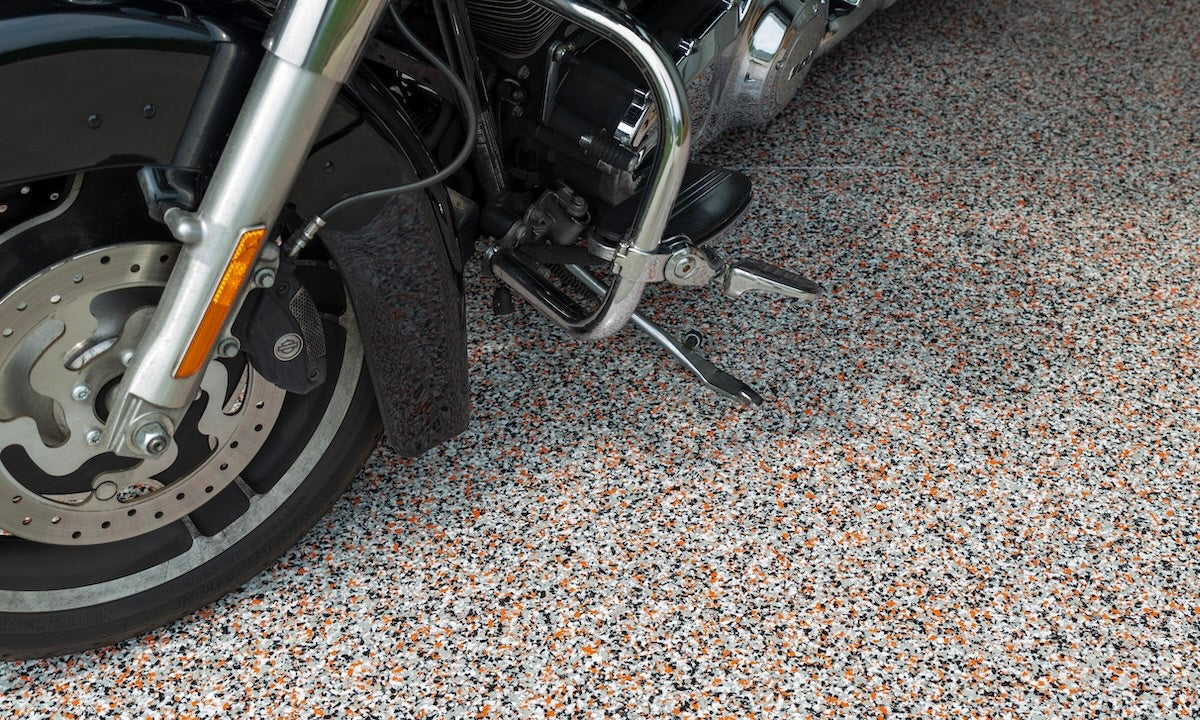
An epoxy flake garage floor combines a durable resin coating with decorative flakes that add color, texture, and visual depth to your garage floor. The result is a finished surface that transforms bare concrete into a cleaner, more polished, and more functional space.
Flake flooring is ideal for garages because the multicolor pattern helps disguise dust, debris, surface variation, and everyday wear. When installed over properly prepared concrete and protected with a durable topcoat, a flake garage floor coating can handle parked vehicles, rolling toolboxes, storage equipment, household projects, and regular foot traffic.
Before choosing a system, it is important to understand how flake floors work, what affects their durability, how much they cost, and what is required to install and maintain them properly.
What is an Epoxy Flake Garage Floor?
An epoxy flake garage floor is a layered coating system installed over concrete. Decorative polymer floor flakes are broadcast into a wet coating and then sealed beneath a clear protective topcoat.
A typical Stone Coat flake flooring kit includes:
- Floor Patch Epoxy Gel, when needed, to repair cracks, chips, pits, and other surface imperfections before coating.
- Moisture Seal Epoxy Flooring Primer, which primes the prepared concrete, helps control moisture, and provides the base for the flake broadcast.
- Polymer Floor Flake, broadcast directly into the wet Moisture Seal Epoxy Primer to create the color, pattern, and texture.
- Polyaspartic Flooring Top Coat, applied over the scraped flake surface to provide the final durable, protective finish.
- Non-Skid Floor Additive, which can be mixed into the Polyaspartic Top Coat for additional traction.
Stone Coat flake flooring kits are designed as complete systems, with products for repairing, priming, coating, and protecting the finished floor. The current Stone Coat Flake Floor Kit is available in hundreds of solid and blend options for garages, workshops, and other high-traffic spaces.
Why Use Garage Floor Flakes?
Garage floor flakes provide more than a decorative pattern. They can improve the floor’s appearance, help hide everyday wear, add texture, and create a more finished space.
They Hide Dirt and Everyday Wear
Solid-color floors can show dust, footprints, small scratches, and surface inconsistencies. A blended flake pattern breaks up the floor's appearance, making everyday garage debris less noticeable between cleanings.
This can be particularly helpful in garages used for woodworking, automotive work, lawn equipment storage, home improvement projects, or other activities that create dust and dirt.
They Create a More Finished Appearance
Bare concrete can make a garage feel unfinished, even when the space is clean and organized. An epoxy flake garage floor creates a seamless, professional-looking finish that helps the garage feel more polished and connected to the rest of the home.
Neutral blends in gray, black, white, tan, and stone-inspired tones coordinate easily with cabinets, wall colors, and storage systems. For a more personalized look, bolder flakes can introduce blue, red, green, or other accent colors. Team colors can also be combined to create a custom floor for a man cave, sports-themed garage, game room, or home gym.
They Add Texture to the Surface
Polymer flakes create physical texture within the coating. After the excess flakes are removed and the surface is top coated, the floor retains a lightly textured profile instead of appearing completely flat.
The final traction level depends on the amount and size of flake, how aggressively the broadcast floor is scraped, the topcoat application, and whether Stone Coat Non-Skid Floor Additive is included. Any coated floor may become slippery when wet, so traction requirements should be considered before installation.
They Help Cover Minor Visual Imperfections
A full-broadcast flake system can help disguise minor color variation and small cosmetic inconsistencies in the concrete; however, garage epoxy flakes do not repair cracks, pits, moisture problems, contamination, or unstable concrete.
Those issues must be addressed during surface preparation. Flakes improve the appearance of the finished floor, but they cannot compensate for a weak or poorly prepared substrate.
How Durable Is a Flake Garage Floor Coating?
A properly installed flake garage floor coating is highly durable and can last 20 years or more with proper care. Its longevity depends almost entirely on what sits above and below the flakes: the concrete prep underneath and the topcoat on top.
Concrete preparation is one of the most important factors in the performance of a flake floor. The surface should be structurally sound, clean, dry, moisture controlled, and free from oil, silicone, grease, loose coatings, and other contaminants that could interfere with adhesion. The concrete should also be mechanically prepared, typically by diamond grinding, to remove weak surface material, open the pores, and create the proper profile for the coating system to bond.
The clear top coat also plays a major role because it becomes the surface exposed to tires, chemicals, water, tools, and regular use. Stone Coat flake systems are finished with a Polyaspartic Flooring Top Coat designed to resist water, stains, chemicals, scratching, and UV-related discoloration.
A properly installed floor can provide long-term performance, but no coating is completely maintenance-free or damage-proof. Sharp metal objects, dragging heavy equipment, welding, harsh chemical exposure, concrete movement, moisture vapor, and improper cleaning products can all negatively affect the finish.
Full-Broadcast vs. Partial-Broadcast Flake Floors
The amount of flake used changes both the appearance and performance of a flake floor. A lighter broadcast leaves more of the base epoxy primer color visible, while a full broadcast creates denser coverage, greater texture, and a more uniform finish.
| Full-Broadcast | Partial-Broadcast | |
|---|---|---|
| Flake Material Use | Higher flake usage, broadcast until the surface will no longer accept more material | Lower flake usage with flakes applied more selectively |
| Base Coat Visibility | Little to no base coat remains visible | More of the base coat remains visible |
| Coverage & Uniformity | Dense, consistent coverage that helps minimize visible variation | More variation is visible, making even distribution more important |
| Texture | Creates more surface texture | Creates a lighter, less textured finish |
| Hides Dirt Between Cleanings | Better at disguising dust, dirt, and minor debris | Shows more of the underlying floor and may reveal dirt more easily |
| Application Difficulty | More forgiving visually because the surface is fully covered | Can be more difficult to apply evenly without heavy spots or bare areas |
| Look | Full, layered, professional appearance | Lighter, more decorative flake effect |
| Best Suited For | Garages, workshops, home gyms, utility spaces, and high-use areas | Spaces where a lighter decorative finish and more visible base color are preferred |
Full-Broadcast Flake Floors
With a full broadcast, garage floor flakes are thrown generously into the wet coating until the surface will no longer accept more material. The floor should appear completely covered, with little or no visible base coat remaining.
After curing, loose flakes are removed, and the surface is scraped before the clear top coat is applied.
Partial-Broadcast Flake Floors
A partial broadcast uses fewer flakes, allowing more of the colored base coat to remain visible. This produces a lighter decorative effect.
For most garage applications, a full-broadcast flake system provides the most consistent appearance, greater texture, and better coverage for everyday use.
 Partial, Mid & Full Flake Coverage
How to Choose Garage Epoxy Flakes
Choosing a floor flake involves more than finding a color you like. Consider how the finished floor will relate to the garage, lighting, vehicles, cabinets, and expected use.
Consider the Size of the Garage
Dark floors can look bold and modern, but they can also make a small or poorly lit garage feel darker and smaller. Lighter gray, white, tan, and neutral blends can help brighten the space and visually open it up.
A large garage can support darker or more dramatic combinations without feeling closed in.
Look at the Dominant Color
Most blends contain several colors, but one or two tones usually dominate the finished appearance. Focus on the overall color from a distance rather than judging each individual flake.
A blend containing black, white, and several shades of gray may appear medium gray once installed. A tan blend with small black and white accents may still read as warm beige across the entire floor.
Coordinate With Permanent Features
Consider the colors of your garage doors, cabinets, workbenches, wall paint, storage systems, and exterior finishes. These items may remain in place longer than your current vehicle or temporary storage.
Neutral flakes are easier to coordinate with future changes, while custom colors can make the floor a stronger design feature. A custom blend can also tie the space together by matching cabinets, wall colors, vehicles, brand colors, or a favorite sports team.
Decide How Much Dirt You Want the Floor to Hide
Light floors may show tire marks and dark debris more easily. Dark floors can make sawdust or grass clippings more noticeable.
Medium-value blends containing multiple shades often provide the best balance for active garages and workshops.
What Does an Epoxy Flake Garage Floor Cost?
A DIY epoxy flake garage floor costs approximately $1.99 to $2.50 per square foot with a Stone Coat system, compared with about $5 to $7 per square foot for professional installation.
The total cost depends on the square footage, concrete condition, preparation requirements, moisture control, repair work, flake selection, and other project-specific needs. Depending on the project, choosing a DIY Stone Coat system may reduce the total cost by approximately 60 to 75 percent compared with professional installation.
Professional installation generally costs more because labor, equipment, surface preparation, and contractor overhead are included. A DIY system can reduce labor costs, but the project still requires the correct materials, preparation equipment, safety gear, mixing tools, rollers, squeegees, spiked shoes, and cleanup supplies.
When comparing systems, confirm what is included in the advertised price. A complete Stone Coat flake flooring project may require Floor Patch Epoxy Gel for repairs, Moisture Seal Epoxy Primer, polymer flakes, Polyaspartic Top Coat, and an optional Non-Skid Floor Additive, along with the tools and equipment needed for preparation and application.
Material needs and final costs will vary based on the condition and square footage of the floor. That said, the lowest-priced coating is not going to give you the lowest-cost floor over time. Skipping moisture testing, mechanical preparation, crack repair, or the proper topcoat can lead to peeling, bubbling, delamination, or premature wear.
Can You Install an Epoxy Flake Garage Floor Yourself?
A DIY epoxy flake garage floor is possible for homeowners who are prepared to follow the complete system and work within the required application windows.
The installation process generally includes three major phases:
- Preparing and repairing the concrete
- Applying the coating and broadcasting the garage floor flakes
- Scraping the flakes and applying the protective topcoat
Each phase affects the next. A well-broadcast flake layer cannot correct poor concrete preparation, and a quality topcoat cannot prevent failure if the coating underneath did not bond properly.
Before beginning, review tutorials, detailed instructions, coverage rates, temperature requirements, recoat windows, and cure times for each product in the system. Confirm that you have enough material for the entire floor before mixing the first batch.
Stone Coat provides a complete step-by-step flake flooring tutorial covering surface preparation, repairs, coating, flake broadcasting, scraping, and topcoat application.
Common Epoxy Flake Garage Floor Mistakes
Even a high-quality coating system can fail or look uneven when key preparation and application steps are missed. Avoid these common epoxy flake garage floor mistakes to achieve a smoother, more durable, and professional-looking finish.
Coating Over Contaminated Concrete
Oil, grease, silicone, tire treatments, paint, adhesive, and cleaning residue can prevent the coating from bonding. Concrete must be properly cleaned and mechanically prepared, not simply swept or pressure washed.
Ignoring Moisture
Moisture moving through concrete can place pressure beneath the coating, causing bubbles, blistering, peeling, or delamination from the surface. Moisture conditions should be evaluated before installation, and a moisture-control primer like Moisture Seal Epoxy Flooring Primer should be used before applying flake.
Using Too Little Flake
A full-broadcast floor requires more material than a light decorative sprinkle. Running short can leave visible base-coat areas and uneven coverage.
Order according to the system’s coverage recommendations and allow for edges, waste, throwing technique, and project-specific needs.
Throwing Flakes Directly Down
Garage epoxy flakes should be broadcast upward and outward, like you’re feeding chickens, so they spread out and fall naturally onto the wet coating. Throwing them directly at the floor can create piles, stripes, and concentrated spots.
Applying the Topcoat Unevenly
An inconsistent topcoat can leave dry areas, heavy sections, trapped debris, milky spots, or an uneven sheen. Work in controlled sections and follow the recommended coverage rate, mixing instructions, and application method.
Returning the Garage to Service Too Soon
A coating may feel dry before it has reached the required cure time for vehicle traffic, heavy equipment, or chemical exposure. Follow the product-specific cure schedule before moving items back into the garage.
How Do You Maintain a Flake Garage Floor?
Routine cleaning helps protect the appearance of the floor and prevents abrasive dirt from building up.
Sweep or vacuum loose debris regularly. For deeper cleaning, use a soft-bristle broom or mop with water and a coating-safe cleaner. Avoid harsh or highly abrasive products unless they are approved for the topcoat.
Clean automotive fluids, chemicals, paint, and other spills as soon as possible. Although a quality topcoat provides chemical and stain resistance, extended exposure can still affect the surface.
Use mats or protective pads beneath equipment with sharp feet. Avoid dragging metal cabinets, machinery, or heavily loaded storage units across the floor. During winter, remove standing water, road salt, and deicing residue regularly.
Are Epoxy Flake Floors Only for Garages?
Flake flooring can be used in many residential and commercial spaces, including:
- Workshops
- Home gyms
- Basements
- Utility rooms
- Laundry rooms
- Storage areas
- Retail spaces
- Commercial work areas
The same qualities that make a flake garage floor coating practical for vehicles and tools also make it useful in spaces that need a durable, decorative, and easy-to-clean surface.
Is an Epoxy Flake Garage Floor Right for You?
An epoxy flake garage floor coating is a strong choice when you want a durable coating that helps hide dirt, improves the appearance of concrete, and holds up to regular garage use.
The most successful floors begin with careful preparation. Evaluate the condition of the concrete, address repairs and moisture, choose a flake blend that works with the space, and use a complete coating system designed to work together, such as a Stone Coat Flake Floor Kit.
With hundreds of available flake blends and complete project systems for preparation through topcoat, Stone Coat makes it possible to create a professional-looking garage floor without piecing together incompatible products or breaking the bank.
For a more in depth look, read Is Epoxy Flooring Right for Your Garage?
Ready to transform your garage? Explore Stone Coat Flake Floor Kits and choose the color, coverage, and kit size that fits your space.
