

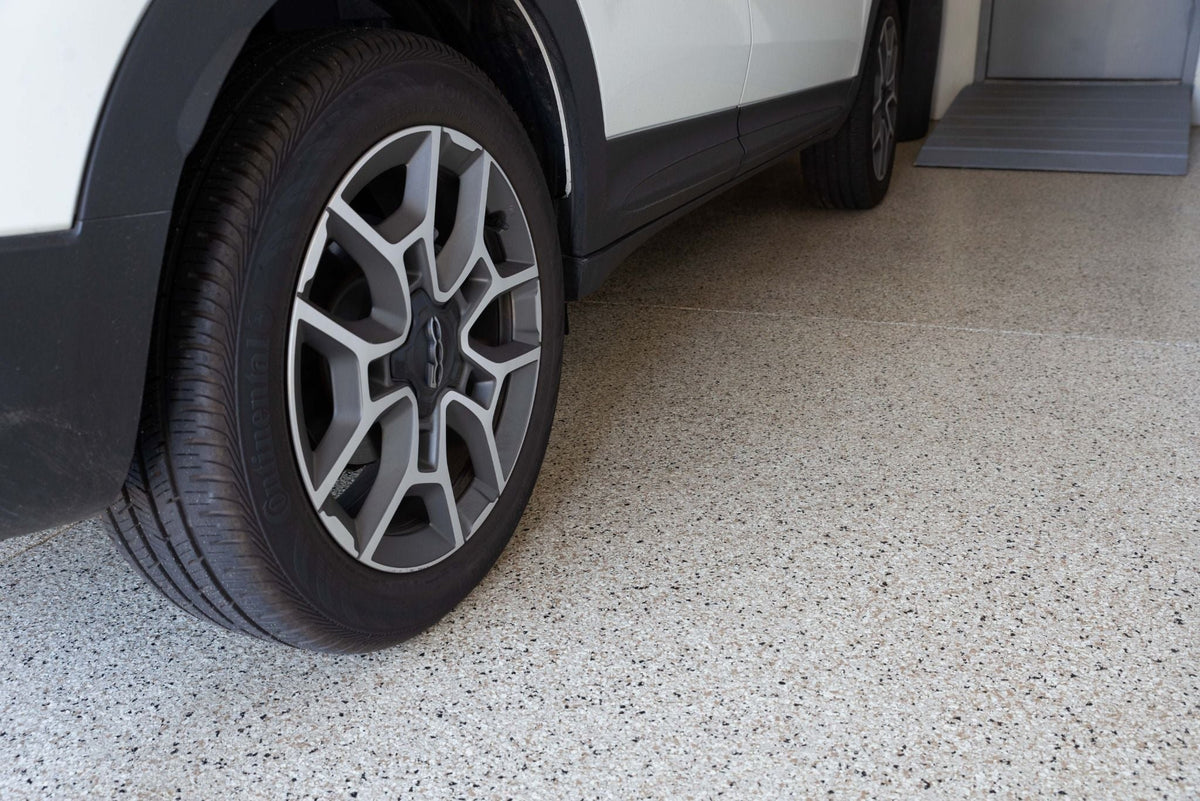
An epoxy garage floor can be so much more than a bland gray coating over concrete. Today’s garage floor designs range from neutral, full-broadcast flake systems to warm earth tones, dark modern finishes, custom color combinations, and metallic epoxy floors with rich, flowing patterns.
Some of the most popular epoxy garage floor ideas include gray and greige flake blends, with greige offering a neutral gray-beige color that works well with both warm and cool finishes, black-and-white combinations, custom color accents, and metallic finishes.
The right design depends on your garage, how you use the space, the amount of maintenance you want, and how you want the garage to connect visually with the rest of your home.
Whether you want a clean, practical garage floor or a high-end space that looks more like a showroom, epoxy gives you a wide range of color and design options.
What Are the Most Popular Epoxy Garage Floor Ideas?
The most popular epoxy garage flooring designs combine a neutral base with decorative flakes in multiple colors. This creates depth and variation while helping disguise dust, debris, surface variation, and everyday wear.
Current flooring and interior design trends are moving toward warmer neutrals, natural colors, richer earth tones, and more personalized color choices rather than relying exclusively on cool gray.

Popular garage floor ideas include:
- Gray, charcoal, white, and black flake blends
- Warm gray and greige floors
- Tan, brown, cream, and earth-tone combinations
- Black and white high-contrast designs
- Dark charcoal and nearly black floors
- Blue, green, red, or other custom accent colors
- Terrazzo-inspired flake combinations
- Metallic epoxy floors
- Marble and natural stone-inspired designs
- Custom colors coordinated with cabinets, vehicles, tools, or wall colors
Stone Coat offers hundreds of floor flake blends, allowing you to choose a combination that suits everything from a traditional two-car garage to a workshop, home gym, or custom automotive space.
Neutral Epoxy Garage Floor Colors
Neutral garage floors remain popular because they are easy to coordinate with cabinets, storage systems, vehicles, walls, and other finishes. However, neutral no longer has to mean plain and boring.
Gray Garage Floors

Gray is still one of the most versatile garage floor colors. Medium gray works particularly well because it gives the floor a clean, finished appearance without creating as much contrast with everyday dust and debris as very dark or very light floors.
A gray flake blend can incorporate several shades rather than covering the floor with one flat color. Mixing light gray, charcoal, white, and black creates visual depth while keeping the overall design neutral.
This works particularly well in garages with black cabinets, stainless steel work surfaces, unfinished wood, or white walls.
Greige and Warm Gray Garage Floors

One of the biggest shifts in current home design is the movement away from cold gray tones toward warmer, more natural neutrals. Warm brown, beige, tobacco, taupe, and earth-inspired tones are becoming more prominent throughout residential interiors. That trend can easily carry into the garage.
Instead of choosing a blue-gray floor, consider a flake blend that combines warm gray with beige, cream, tan, or brown. Greige garage floors work especially well when the garage includes wood cabinets, natural wood accents, warmer wall colors, or finishes that continue from the interior of the home.
Tan, Brown, and Earth-Tone Garage Floors

Warm earth tones are another option for homeowners who want something different from a traditional gray garage.
Brownstone, sand, taupe, tan, cream, and dark brown flakes can create a more natural-looking floor. These colors pair well with wood cabinetry, black hardware, stone exteriors, and warm neutral paint colors.
Earth tones are particularly relevant to 2026 design, where richer browns, olive tones, terracotta, and nature-inspired palettes are replacing some of the stark white and cool gray combinations that dominated previous years.
Black and Dark Garage Epoxy Flooring Ideas

A dark garage floor can give the space a dramatic, modern appearance, particularly in automotive garages, workshops, and finished garages designed to display vehicles, motorcycles, custom builds, tool collections, or other hobby and collector pieces.
Charcoal, graphite, black, and deep gray can be combined with white or lighter gray flakes to create contrast.

Dark floors can look striking with:
- Bright white walls
- Black storage cabinets
- LED lighting
- Stainless steel workbenches
- Red, blue, or other automotive-inspired accent colors
- Natural wood cabinetry
Keep practicality in mind before choosing an extremely dark, solid floor. Dust, footprints, and light-colored debris can be more noticeable against a uniform black surface. Adding multiple flake colors and tonal variation can help break up the surface visually and hide unwanted dirt.
Terrazzo-Inspired Epoxy Flake Floors
Terrazzo continues to influence flooring design in 2026, with designers using both subtle and bold combinations of aggregate-like colors to create floors with character and variation.

An epoxy flake garage floor can create a similar visual effect without trying to duplicate traditional terrazzo.
For a terrazzo-inspired look, consider a lighter base combined with several complementary flake colors. Cream, taupe, gray, charcoal, tan, muted green, or warmer brown combinations can make the floor feel more designed and less industrial.
Larger or mixed-scale decorative elements are also appearing throughout current flooring design, making a varied flake blend a good choice for homeowners who want more visible texture and movement.
Bold Garage Floor Colors
Neutral colors are not your only option.
One of the broader design movements in 2026 is toward more personal spaces with stronger color choices rather than decorating strictly for broad appeal. Deep greens, muted blues, burgundy, brown, and other richer colors are appearing throughout residential design.
The garage is an ideal place to experiment with these colors.
Blue Garage Floors
Blue can range from a subtle accent inside a gray flake blend to a dominant navy, cobalt, or automotive-inspired color.

A mostly gray floor with blue flakes can add color without overwhelming the space. For a stronger look, blue can be coordinated with cabinetry, tool storage, vehicles, or brand colors.
Green Garage Floors
Green is becoming increasingly visible in current interiors, especially deeper, nature-inspired shades like olive, moss, and muted jade.

That direction is carrying into 2027 as well. Behr named Grounded, an earthy olive green with subtle brown undertones, its 2027 Color of the Year. The shade reflects the continued shift toward warmer, nature-inspired colors that feel more organic and less stark than the cool grays that dominated interiors for years.
That same color direction can work surprisingly well in a garage. Olive, moss, and muted green flakes can be mixed with gray, black, cream, tan, or brown to create a floor that feels current without looking overly trendy.
For homeowners who want the garage to feel like a true extension of the home, a Grounded-inspired palette can also help connect the flooring to warm wood cabinetry, black hardware, natural finishes, and earthy wall colors.
Sports and Automotive-Inspired Accent Colors
Red, orange, blue, and other high-energy colors work particularly well as accents in automotive garages and workshops.

Instead of covering the entire floor in a bright color, adding smaller amounts of a bright color to a black, gray, or white flake blend can connect the floor to a favorite vehicle, tool brand, cabinet system, or other elements in the garage. You can even create a garage floor inspired by your favorite sports team's colors.

Metallic Marble Epoxy Garage Floor Ideas
Metallic marble epoxy creates a completely different look from an epoxy flake floor.
Metallic pigments move through the coating to produce variation, depth, and flowing patterns. Depending on the colors and application technique, the finished floor can resemble marble, stone, flowing metal, or an abstract design.

The Stone Coat metallic marble flooring system creates marble-like patterns with depth and movement.
Metallic floors work especially well when the garage functions as more than vehicle storage.
Consider metallic epoxy for:
- Show garages
- Custom automotive spaces
- Home gyms
- Workshops
- Entertainment garages
- Barndominiums
- Finished garages connected to living areas
Black, silver, charcoal, copper, bronze, blue, and earth-tone combinations can all produce dramatically different results.
Because metallic floors create more visible movement, the finished design becomes a major part of the room rather than simply serving as a neutral backdrop.
Flake vs. Metallic Epoxy Floors
Flake and metallic garage floors create very different looks, but both are capable of completely transforming the look and feel of your garage.
An epoxy flake floor uses decorative vinyl flakes broadcast into the coating to add color, texture, and visual variation. Flake flooring is a durable option that can help disguise dirt and wear, making it particularly useful for garages, workshops, and other high-traffic spaces.
 Epoxy Flake Garage Floor: Before & After
Metallic epoxy uses pigments inside the coating to create flowing patterns and natural variation.
 Metallic Marble Epoxy Garage Floor: Before & After
For an everyday working garage, a full-broadcast flake system is often the more practical design choice because the multicolor surface helps visually conceal dust, debris, and minor variation.
For a garage designed to function as a showroom or statement space, metallic epoxy creates a more dramatic custom finish.
Should a Garage Floor Be Glossy or Matte?
Gloss level can drastically change the appearance of the same garage floor design.
A higher-gloss finish, achieved with Stone Coat Ultimate Flooring Top Coat with a Textured Gloss Finish reflects more light and can make colors and metallic effects appear deeper and more saturated. This works particularly well in showroom-style garages and spaces with strong overhead lighting.
A lower-sheen or matte appearance finished with Ultimate Flooring Top Coat Textured Matte creates a softer, more understated look. Matte and natural-looking finishes are also appearing more frequently in broader 2026 flooring trends as homeowners move toward surfaces with more visual texture and less artificial shine.
The right finish should be chosen for both appearance and performance. Garage floors should always use a flooring system and topcoat appropriate for the environment and expected traffic.
How to Choose the Best Epoxy Garage Floor Color
The best garage floor color is one that works with the entire space, not just a color that looks good on a small sample.
Before choosing your floor, consider the following factors.
Your Garage Cabinets
Black, gray, white, wood, red, and blue cabinetry can all influence which flooring colors look best.
Instead of trying to match the cabinets exactly, choose one or two complementary colors from the surrounding space and repeat them subtly within the floor.
Your Garage Wall Color
Consider the undertone of your garage wall color.
A cool gray wall may coordinate well with gray, black, white, or blue flakes. Cream, beige, or warm white walls may work better with greige, taupe, brown, or warmer flake combinations.
How You Use the Garage
A working garage should prioritize a floor that looks good during real-world use.
A multicolor full-broadcast flake floor can help disguise dust, debris, and surface variation between cleanings. A show garage may put greater emphasis on dramatic color, metallic movement, or high contrast.
Your Home’s Overall Style
Garages are increasingly treated as an extension of the home rather than an unfinished utility space.
If the rest of the home uses warm woods and natural colors, a cool industrial gray floor may feel disconnected. A warm gray, greige, brownstone, or natural flake blend can create a smoother transition.
For a modern home with black windows, dark cabinetry, and high-contrast finishes, charcoal, black, white, and gray may make more sense.
What Garage Floor Colors Hide Dirt Best?
Medium-tone, multicolor, epoxy flake floors are generally the most forgiving for everyday garages.
Very light floors can show dark debris, tire marks, and stains more readily. Very dark floors can make dust and light-colored debris more visible.
A medium gray, greige, tan, or mixed neutral flake floor breaks up the surface visually, making small amounts of dust and debris less noticeable. This is one reason decorative flake floors are so commonly used in garages. In addition to adding color and texture, the multicolor pattern helps disguise everyday surface variation.
How to Make an Epoxy Floor Look Custom
A custom garage floor does not necessarily require an extreme color or complicated design.
Start with the elements already in the room. Pull colors from the cabinets, walls, storage system, exterior of the home, or even a favorite vehicle. Then choose a floor with one dominant neutral and one or two secondary colors.
For example:
- Warm modern garage: Greige, cream, taupe, and charcoal.
- Classic garage: Medium gray, black, and white.
- Modern luxury garage: Charcoal, black, silver, and white.
- Natural garage: Tan, brown, cream, and warm gray.
- Automotive garage: Gray, black, white, and a small amount of red or blue.
- Terrazzo-inspired garage: Cream or light gray with varied neutral and earth-tone flakes.
The result can feel intentional without becoming overly busy.
Create Your Own Custom Garage Flooring Design
The best garage epoxy flooring ideas balance design with how the garage is actually used.
Gray and neutral flake floors remain versatile choices, but today’s garage designs are expanding into warmer neutrals, natural earth tones, richer accent colors, terrazzo-inspired combinations, and dramatic metallic finishes.
Stone Coat makes it possible to build a DIY garage floor around the look you want, with hundreds of decorative flake blends along with systems for flake and metallic epoxy flooring.
Start by deciding whether you want your garage floor to blend into the space or become one of its main design features. From there, choose the color palette, flake blend, finish, and flooring system that gives you the appearance and performance your garage needs.
Still deciding whether epoxy is the right choice for your space? Read our guide, Is Epoxy Flooring Right for Your Garage?, to learn more about the benefits, drawbacks, durability, maintenance, and what to consider before you start.
Considering a flake system? Check out Epoxy Flake Garage Floors: Everything You Need to Know for a closer look at colors, flake coverage, durability, installation, and design options.
Ready to dive in? Check out our guides on How to Install an Epoxy Flake Floor Over Concrete or How to Install a Metallic Marble Epoxy Floor Over Concrete for complete step-by-step tutorials.