

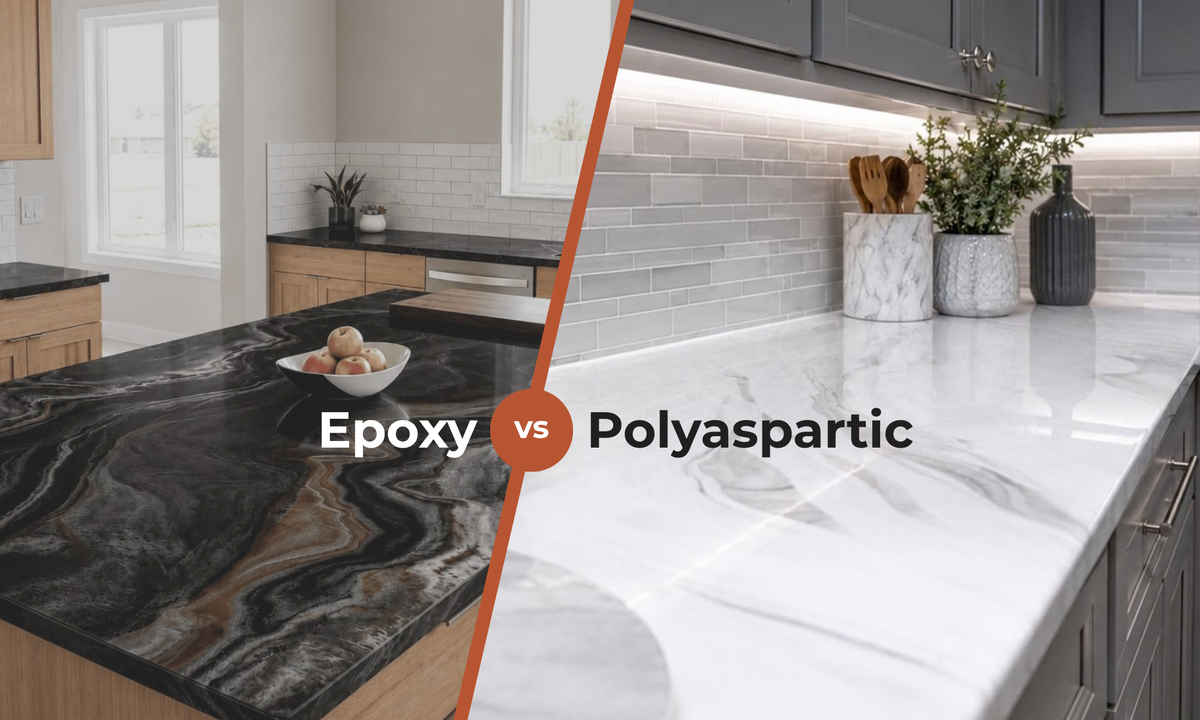
Polyaspartic is the best choice for bright white and light-colored countertops where UV stability and lasting color clarity are priorities. Epoxy is the best choice for richly pigmented, dark, earth-tone, metallic, and highly artistic countertop designs.
Both systems create durable, high-end looking countertop finishes, but they behave differently during application and are designed to solve different problems. Understanding those differences can help you choose the right system before you start your project.
Choosing between epoxy and polyaspartic for countertops is not simply a matter of deciding which coating is better. The right choice depends on the color, design style, application workflow, and performance priorities of your project.
Epoxy vs. Polyaspartic Countertops at a Glance
| Factor | Stone Coat Countertop Epoxy | Stone Coat APEX Polyaspartic |
|---|---|---|
| Core chemistry | Two-part epoxy resin and hardener | Aliphatic polyaspartic technology |
| Best design fit | Dark, earth-tone, richly pigmented, metallic, and artistic designs | Bright white, light-colored, marble-inspired, and quartz-inspired designs |
| Color stability | UV resistant inhibitors slow color change, but epoxy ambers over time | UV-stable performance and lasting clarity for white and light designs |
| Mix ratio | 1A:1B by volume | 2A:1B by volume |
| Working time | 45 minutes | 30–45 minutes |
| Application behavior | Self-leveling; torch used for bubble release on color coats | Moves less and gels quicker; Surface Control workflow; do not torch |
| Light use | 24 hours | 36–48 hours |
| Full cure | 30 days | 7 days |
| Typical material usage | 3–4 oz/sq. ft. hand meld; 6–8 oz/sq. ft. dirty pour | 6–8 oz/sq. ft. hand meld; 8–10 oz/sq. ft. dirty pour |
| Optional top coat timing | After 24 hours | Sand/topcoat after 20–24 hours |
What Is a Polyaspartic Countertop Coating?
A polyaspartic countertop coating like Stone Coat APEX Polyaspartic uses aliphatic polyaspartic chemistry which provides UV-stable performance designed to maintain clarity in light-colored countertop designs.
Polyaspartic is not epoxy.
APEX Polyaspartic is engineered to be poured thick enough to create the depth and appearance associated with stone-inspired countertop designs. It's particularly well suited for bright white, light-colored, white marble-inspired, and white quartz-inspired countertops.

The complete APEX Polyaspartic Countertop System workflow uses a primer, colorants, and finishing spray that are formulated specifically to work with APEX Polyaspartic: Poly Fuse Countertop Primer, Poly White Countertop Dye, APEX Polyaspartic Countertop Coating, and Surface Control Finishing Spray. The system is designed specifically around the characteristics of polyaspartic chemistry rather than trying to make a polyaspartic product behave like countertop epoxy.


What Is an Epoxy Countertop Coating?
An epoxy countertop coating is made by combining a two-part epoxy resin and hardener to create a durable, self-leveling surface.
Stone Coat Countertop Epoxy is especially well-suited for designs where movement, color depth, and artistic freedom are important. Dark marble effects, earth tones, metallic designs, dramatic veins, and heavily pigmented countertops all work well with an epoxy system.

The self-leveling characteristic of epoxy gives creators time to manipulate colors and create movement across the surface. During application, you can use isopropyl alcohol and a torch according to the system instructions to release bubbles and work the surface.
Epoxy offers UV resistance, but its chemistry can amber or change color over time. That makes the design itself an important part of the decision. On darker, richly pigmented, metallic, or earth-tone countertops, slight changes in the coating are generally less visually critical than they would be on a bright white surface.
For a deeper look at what causes epoxy to yellow and how UV exposure can affect color over time, read our Why Does Epoxy Yellow? article.
7 Differences Between Epoxy and Polyaspartic Countertops
The seven differences between epoxy and polyaspartic countertop coatings are:
- Color and UV stability
- Best design styles and colors
- Flow, movement, and bubble control
- Working time and application pace
- Light-use time and full cure
- Coverage and total project cost
- Surface prep and compatibility
Understanding how each factor affects the final look, application process, and long-term performance can help you choose the right coating for your countertop project.
Color and UV Stability
The biggest difference between epoxy and polyaspartic countertops may be how each system suits different color palettes.
Countertop Epoxy contains UV-resistant properties designed to slow color change, but all epoxy can yellow over time. The APEX Polyaspartic technology is designed for lasting clarity, making it especially useful when maintaining a bright white or light-colored surface is important.
Best Design Styles and Colors
Epoxy provides more freedom for richly colored and highly artistic designs, while APEX Polyaspartic is particularly well suited for white and light stone-inspired finishes.
Choose Countertop Epoxy when you want deep colors, earth tones, metallic effects, dramatic veins, or a design with significant movement.
Choose APEX Polyaspartic for bright white, light-colored, marble-inspired, or quartz-inspired countertops where maintaining long-term color clarity is a priority.
Flow, Movement, and Bubble Control
Countertop Epoxy is self-leveling and offers more movement during the application process. The epoxy coating workflow can include using a torch for bubble release and 91% isopropyl alcohol for bubble release and cell creation.
APEX Polyaspartic moves less and gels more quickly. Instead of using heat, the APEX Polyaspartic system uses Surface Control Finishing Spray for bubble release and surface control.
Do not use a torch or isopropyl alcohol on APEX.
That distinction is important because techniques that work with epoxy should not automatically be carried over to polyaspartic.
Working Time and Application Pace
Countertop Epoxy offers approximately 45 minutes of working time, while APEX Polyaspartic offers approximately 30 to 45 minutes.
Because APEX Polyaspartic gels more quickly and has less movement, the application experience feels different even when the listed working times overlap. Preparation steps such as planning your colors, setting up your tools, and the pouring process before mixing are especially important with APEX.
Light-Use Time and Full Cure
Countertop Epoxy can typically return to light use after approximately 24 hours, but the full cure is 30 days.
APEX Polyaspartic requires approximately 36 to 48 hours before light use but reaches full cure much sooner, at approximately seven days.
A faster full cure can be an advantage when the overall project schedule matters, while the slightly longer wait before light use should still be considered when planning the installation.
Coverage and Total Project Cost
Countertop Epoxy and APEX Polyaspartic require different amounts of material per square foot, so comparing container prices alone does not give you an accurate picture of total project cost.
Countertop Epoxy typically uses approximately 3 to 4 ounces per square foot for a hand-meld design and 6 to 8 ounces per square foot for a dirty pour.
APEX Polyaspartic typically uses approximately 6 ounces per square foot for a hand-meld and approximately 8 to 10 ounces per square foot for a dirty pour.
Calculate the total amount of coating required for your specific design before comparing project costs. Coverage requirements, the countertop size, design technique, primer requirements, and optional top coats can all affect the final cost.
Surface Prep and Compatibility
Both Countertop Epoxy and APEX Polyaspartic depend heavily on proper surface preparation.
Depending on the applicable system instructions, compatible countertop substrates can include laminate, tile, cultured marble, granite, quartz, marble, MDF, wood, and existing epoxy.
The correct prep process is determined by both the substrate and the coating system being applied. Do not assume that an epoxy prep method and an APEX Polyaspartic prep method are interchangeable. Always follow the instructions for the specific Stone Coat system you are using.
Which Countertop Coating Should You Choose?
Choose epoxy if your project includes dark colors, earth tones, rich pigments, metallic effects, dramatic veins, or a highly customized artistic design. Countertop Epoxy is also a strong choice when you prefer a self-leveling coating with more movement and a familiar epoxy application workflow.

Choose APEX Polyaspartic if your project is bright white, light-colored, white marble-inspired, or white quartz-inspired. APEX Polyaspartic is designed for projects where UV stability and maintaining color clarity are particularly important.

Neither system is the right choice for every countertop. The design you want to create should help determine the chemistry you use rather than trying to force one coating to handle every type of project.
Can You Apply Polyaspartic Over Existing Epoxy Countertops?
Yes, APEX Polyaspartic can be applied over an existing epoxy countertop when the existing coating is solid, stable, and properly prepared according to the APEX Polyaspartic system instructions.
APEX Polyaspartic should not be treated as a drop-in replacement for an epoxy top coat. Converting an existing epoxy surface to APEX Polyaspartic requires following the complete approved preparation process, including Poly Fuse Primer where directed.
Frequently Asked Questions
Is polyaspartic better than epoxy for countertops?
Neither coating is universally better. Epoxy is generally better suited for dark, richly pigmented, metallic, earth-tone, and highly artistic designs.
A polyaspartic system such as APEX Polyaspartic is better for white and light-colored countertops where UV stability and long-term clarity are priorities.
Is Stone Coat APEX epoxy?
No. Stone Coat APEX is a complete polyaspartic countertop coating system with its own mixing, preparation, application, and finishing process.
Which coating is better for white countertops?
APEX Polyaspartic is specifically designed for bright white and light-colored countertops. Its UV-stable polyaspartic chemistry makes it the better-fitting Stone Coat system when maintaining a white or light appearance is a primary goal.
Does polyaspartic yellow?
The APEX Polyaspartic technology is designed for UV-stable performance and lasting color clarity, particularly for white and light countertop designs, with UV chamber testing done by Stone Coat indicating 20+ years of color stability under accelerated testing conditions.
Is polyaspartic more expensive than epoxy for countertops?
The total project cost depends on the amount of material required, the design, the countertop size, preparation requirements, and the complete system being used. Because epoxy and APEX Polyaspartic have different coverage rates, compare total project requirements rather than simply comparing the price of individual containers.
Which coating gives you more working time?
Countertop Epoxy allows approximately 45 minutes of working time. APEX Polyaspartic allows approximately 30 to 45 minutes, but APEX Polyaspartic moves less and gels more quickly, creating a different application experience.
How long do epoxy and APEX Polyaspartic take to cure?
Countertop Epoxy can return to light use after approximately 24 hours and reaches full cure after 30 days. APEX Polyaspartic can return to light use after approximately 36 to 48 hours and reaches full cure after seven days.
The Bottom Line
The best countertop coating comes down to the look you want to create and the performance your project requires. Stone Coat Countertop Epoxy gives you the movement, working time, and design flexibility needed for richly pigmented, dark, earth-tone, metallic, and artistic finishes, while Stone Coat APEX Polyaspartic is engineered for bright white and light-colored stone-inspired designs where UV stability and long-term color clarity are priorities.
Explore our Epoxy Countertop Kits for traditional epoxy projects or shop the APEX Countertop System for white and light-colored countertops. If you want to get familiar with the APEX workflow before taking on a full-size project, the APEX Polyaspartic Sample Kit is an easy way to practice the process on a smaller scale.
To keep exploring your options, check out our Epoxy Countertop Designs for inspiration on marble, metallic, and other finishes you can create with Stone Coat systems.