

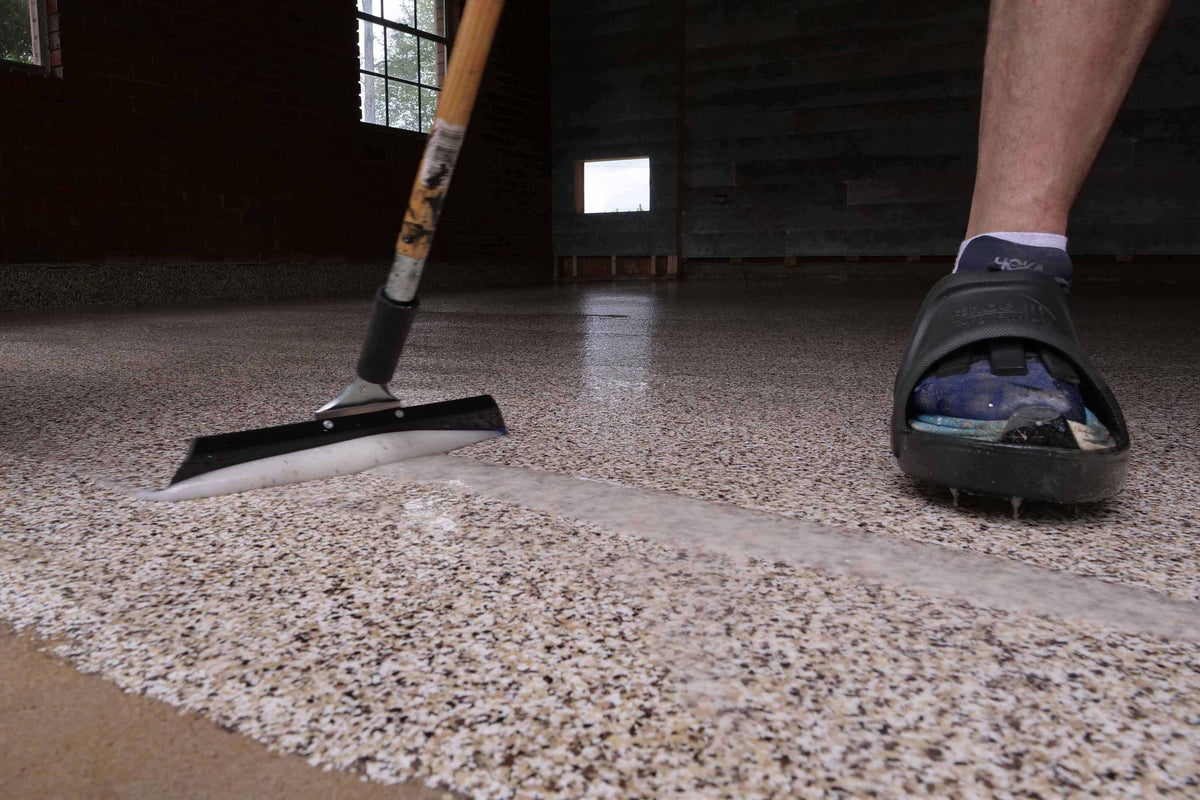
Polyaspartic coating is a two-component protective coating in the polyurea family, known for its fast curing, UV stability, durability, and resistance to everyday wear. Commonly used on concrete and garage floors, polyaspartic technology also has applications for countertops.
Stone Coat Countertops uses specially formulated polyaspartic coatings to protect epoxy flake floors and to create bright white, color-stable countertops with its APEX Polyaspartic Countertop System.


What Is Polyaspartic Coating?
Polyaspartic coating is a protective coating made through a chemical reaction between a polyaspartic ester resin and an aliphatic polyisocyanate hardener. These two components react to create a strong, durable surface that resists wear, moisture, and many common chemicals.
Polyaspartic coatings belong to the polyurea family, but their chemistry allows manufacturers to control properties such as working time, curing speed, flexibility, and durability.
Originally developed for industrial protective coatings, polyaspartic technology is now used in residential garages, commercial flooring, workshops, and even decorative countertops. One important distinction is that polyaspartic refers to a type of coating technology, not one specific product. Different formulas are designed for different surfaces and applications.
For example, a polyaspartic floor coating designed to protect concrete from vehicle traffic is not the same as a decorative countertop coating designed to create the look of marble or quartz.
Polyurea vs. Polyaspartic: What's the Difference?
Polyurea and polyaspartic coatings are closely related, but they have differences in chemistry, UV stability, curing speed, and performance.
Polyurea forms through a chemical reaction between an isocyanate and an amine. Polyaspartic is a modified type of aliphatic polyurea that uses polyaspartic ester resins to help control the curing reaction.
This means all polyaspartic coatings belong to the polyurea family, but not all polyurea coatings are polyaspartic.
Key Differences Between Polyurea and Polyaspartic
| Feature | Polyurea | Polyaspartic |
|---|---|---|
| Chemistry | Can use aromatic or aliphatic isocyanates and amines | Uses polyaspartic ester resins with polyisocyanate hardeners, commonly aliphatic |
| UV stability | Aromatic formulations can yellow and chalk with sunlight exposure | Aliphatic formulations provide improved UV and color stability |
| Working time | Many fast-reacting systems require specialized application equipment | Can be formulated for longer working times and conventional application methods |
| Flexibility | Certain formulations offer high flexibility and impact resistance | Can be formulated for hardness, abrasion resistance, and chemical resistance |
| Common flooring applications | Base coats and protective coating systems | Clear protective topcoats and decorative flooring systems |
One of the biggest differences is how these coatings respond to sunlight. Aromatic polyureas are more susceptible to discoloration and surface changes with UV exposure. Aliphatic polyaspartic coatings offer improved color stability, making them particularly useful for decorative surfaces where maintaining the original appearance matters.
Working time is another important consideration. Many conventional polyurea systems react rapidly and require specialized spray equipment. Polyaspartic chemistry allows manufacturers to adjust the curing speed, making certain formulations easier to apply with rollers and other conventional tools.
However, working time, flexibility, hardness, and durability vary by product. Neither coating type has the same performance characteristics across every formulation.
How Does Polyaspartic Coating Work?
Polyaspartic coatings work by combining two reactive components, commonly called Part A and Part B. Once mixed, a chemical reaction begins that transforms the liquid coating into a solid protective layer.
Part A typically contains the polyaspartic resin, while Part B contains the isocyanate hardener. When combined in the correct ratio, the materials react and begin forming a durable film.
Unlike coatings that primarily dry through water or solvent evaporation, two-component polyaspartic coatings cure through a chemical reaction.
This reaction helps polyaspartic coatings achieve faster curing times than many conventional epoxy systems, although the actual speed depends on the formulation.
Several factors influence how the coating performs:
- Working time: How long the mixed material remains workable before it begins to thicken.
- Cure time: How long the coating takes to develop the properties needed for handling or use.
- Film thickness: The amount of coating applied to the surface, which can affect protection and performance.
- Temperature and humidity: Environmental conditions that can influence application and curing.
- Surface preparation: Proper preparation helps the coating bond to the underlying material.
Some formulations are designed for rapid professional installation, while others provide additional working time for DIY applications.
Always follow the manufacturer's technical data sheet for mixing ratios, application temperatures, working times, recoat windows, and curing requirements.
What Are the Benefits of Polyaspartic Coating?
The benefits of polyaspartic coating include UV stability, faster curing, abrasion resistance, chemical resistance, water resistance, and a durable protective surface.
These properties make polyaspartic technology useful for both residential and commercial applications. However, performance depends on the specific coating, how it is applied, and the conditions the finished surface experiences.
Key Benefits of Polyaspartic Coating
| Benefit | What It Means | Important Consideration |
|---|---|---|
| UV and color stability | Helps preserve color and clarity when exposed to light | Color performance depends on the exact formula and exposure conditions |
| Faster curing | Can reduce downtime compared with many conventional coating schedules | Working time and return-to-service times vary by product |
| Wear and abrasion resistance | Supports high-use floors and protective surfaces | Performance depends on preparation, film thickness, traffic, and maintenance |
| Chemical and stain resistance | Helps protect surfaces against common spills and exposure | Resistance varies by chemical type, concentration, and contact time |
| Water resistance | Helps create a sealed, cleanable surface | A water-resistant coating does not automatically make the entire system waterproof |
| Gloss and clarity | Can enhance floor flake color and light countertop designs | Gloss and clarity depend on the formula and application method |
What Are the Limitations of Polyaspartic Coating?
While polyaspartic coatings offer several performance advantages, they are not the right choice for every project.
Understanding their limitations helps homeowners and professional installers choose the best coating system for their needs.
- Shorter working times: Some polyaspartic formulations cure quickly, leaving less time to spread and level the material. This can make larger projects more challenging without proper planning.
- Temperature and humidity sensitivity: Environmental conditions can affect how a polyaspartic coating applies and cures. Products must be used within their specified application conditions.
- Surface preparation requirements: Polyaspartic coatings still require proper preparation. Concrete may need mechanical grinding, crack repair, cleaning, and moisture evaluation before coating.
- Product compatibility: Not every polyaspartic formula is compatible with every primer, existing coating, or substrate. Products should be used within an approved system.
- Material cost: Some polyaspartic coatings have higher upfront material costs than conventional epoxy products. Faster curing may help offset costs in certain professional applications.
- Slippery surfaces: Smooth, high-gloss floor coatings may become slippery when wet. A compatible non-skid additive or textured finish may be needed to improve traction.
For the best results, choose a coating designed for the intended application rather than selecting a product based on curing speed alone.
Where Is Polyaspartic Coating Used?
Polyaspartic coating is commonly used for garage floors, concrete surfaces, workshops, and commercial flooring. Specialized formulations are also used for industrial protective coatings and decorative countertops.
The role of the coating changes depending on the surface and the system it is designed to work with.
Common Applications for Polyaspartic Coating
| Use | Role of Polyaspartic | Stone Coat Product Path |
|---|---|---|
| Epoxy flake floors | Clear protective topcoat over epoxy primer and floor flake | Epoxy Flake Floor Kit and Polyaspartic Flooring Top Coat |
| Garage, basement, and workshop floors | Provides top-layer protection, gloss, and UV-stable performance | Epoxy Flake Flooring |
| Professional floor installations | Offers a faster-curing system option for trained crews and PROs. | Polyaspartic PRO Flooring Top Coat |
| Light and white countertops | Serves as the core decorative coating in a purpose-built countertop system | APEX Polyaspartic Countertop System |
| Industrial and protective coatings | Provides formulation-specific protection for steel, concrete, and other substrates | Use a coating system approved for the substrate and exposure conditions |
Two of the most common uses for the Stone Coat polyaspartic technology are epoxy flake flooring and decorative countertops.
Although both applications use polyaspartic chemistry, the products are formulated for different purposes and are not interchangeable.
Polyaspartic Coating for Epoxy Flake Floors
Polyaspartic floor coating is commonly used as the final protective layer in decorative concrete flooring systems.
For the Stone Coat epoxy flake flooring system, a polyaspartic topcoat is applied over the epoxy primer and decorative floor flake to create a durable, high-gloss surface.

The products work together to create a finished floor:
- Epoxy primer: Bonds to the properly prepared concrete and provides the base for the flooring system.
- Floor flake: Creates the decorative color and texture of the floor.
- Polyaspartic Flooring Top Coat: Seals and protects the decorative flakes while adding gloss, UV stability, and resistance to everyday wear.
This combination uses the strengths of both epoxy and polyaspartic technology rather than relying on one coating to perform every job.
Stone Coat Polyaspartic Flooring Top Coat is formulated for DIY flooring applications, providing a durable, high-gloss surface with working time intended to be manageable for homeowners.
For professional installers, the Polyaspartic PRO Flooring Top Coat offers a faster-curing alternative designed for efficient installation.
Proper concrete preparation, crack repair, moisture evaluation, and compatible coating layers remain essential for successful results.
For a complete look at the installation process, read our Epoxy Flake Garage Floors: The Complete Guide.
Polyaspartic Coating for Countertops
Polyaspartic coating is not limited to flooring. With the right formulation, it can also be used to create durable, decorative countertops.
Stone Coat developed its APEX Polyaspartic Countertop System around aliphatic polyaspartic technology specifically for white and light-colored countertop designs.
Countertop epoxy can develop an amber tint with UV exposure, which is particularly noticeable on bright white surfaces.
APEX Polyaspartic uses UV-stable, color-stable chemistry to help preserve whites and maintain the clarity of marble-inspired, quartz-inspired, and other light-colored countertop designs.
Unlike a thin protective floor coating, APEX Polyaspartic Countertop Coating is formulated to create the depth and movement associated with decorative stone surfaces.
How the APEX Polyaspartic Countertop System Works
The APEX system uses four components designed to work together:
- APEX Poly Fuse Countertop Primer: Prepares the properly sanded surface and creates the foundation for the countertop coating.
- APEX Poly White Countertop Dye: Creates bright white color for marble-inspired and other light-colored designs.
- APEX Polyaspartic Countertop Coating: Provides the decorative coating with UV-stable clarity and durability.
- APEX Surface Control Finishing Spray: Helps release bubbles during the application process without using a torch.
The coating can be used to create flowing marble veins, soft white movement, and other natural stone-inspired effects.
It's important to understand that APEX Polyaspartic is not epoxy, and it is not a flooring topcoat. It is a purpose-built countertop system with its own preparation, mixing, application, and finishing requirements.
Likewise, Stone Coat Polyaspartic Flooring Top Coat should not be substituted for the APEX Polyaspartic Countertop Coating.
Learn more about the APEX Polyaspartic Countertop System and how its components work together to create white and light-colored countertops.
What is the Difference Between Polyaspartic and Epoxy?
Neither polyaspartic nor epoxy is automatically better for every project. Both offer distinct advantages, and the right choice depends on the surface, design, installation requirements, and expected use.
Epoxy and Polyaspartic Coatings: Key Differences at a Glance
| Feature | Epoxy | Polyaspartic |
|---|---|---|
| Chemistry | Two-component epoxy resin system | Two-component coating in the polyurea family |
| Working time | Often offers longer working times | Varies by formula; some cure more quickly |
| UV stability | Many traditional formulas can yellow with sunlight exposure | Aliphatic formulations offer strong UV and color stability |
| Curing | Often requires longer before returning to service | Can provide faster return to service |
| Common applications | Primers, decorative coatings, countertops, and flooring | Protective floor coatings, industrial coatings, and specialized countertops |
For epoxy flake floors, the two coating technologies can complement each other. Epoxy provides a strong base for the decorative flakes, while polyaspartic forms the protective top layer.
For countertops, the decision depends heavily on the desired appearance. Epoxy remains an option for dark, metallic, and richly pigmented designs, while APEX Polyaspartic is formulated specifically for white and light-colored surfaces where color stability is a priority.
For a more detailed comparison of countertop coatings, read our guide to epoxy vs. polyaspartic countertops.
Frequently Asked Questions About Polyaspartic Coating
What is polyaspartic coating made of?
Polyaspartic coating is typically made from two components: a polyaspartic ester resin and an aliphatic polyisocyanate hardener. When combined, these materials react to form a durable protective coating. Manufacturers adjust the formulation to control properties such as working time, curing speed, gloss, flexibility, and chemical resistance.
Is polyaspartic the same as polyurea?
Polyaspartic coatings are a specialized type of aliphatic polyurea, but not all polyurea coatings are polyaspartic. Polyaspartic technology uses a particular resin chemistry that allows manufacturers to adjust the reaction speed and application properties. This makes certain formulations suitable for flooring, decorative surfaces, and protective coatings.
What is polyaspartic coating used for?
Polyaspartic coating is used to protect concrete floors, garage floors, commercial spaces, and industrial surfaces. It is especially common as a clear protective topcoat over decorative flooring systems. Specialized formulations, such as Stone Coat APEX Polyaspartic, can also be used to create decorative countertops with UV-stable color and clarity.
Is polyaspartic better than epoxy?
Polyaspartic is not necessarily better than epoxy. Polyaspartic coatings often offer stronger UV stability and faster curing, while epoxy can provide longer working times and excellent performance in primers and decorative coating layers. The best choice depends on the project, and some systems intentionally use both technologies together.
Can polyaspartic coating go over epoxy?
Yes, polyaspartic coating can be applied over compatible epoxy coatings when the system is designed for that application. The Stone Coat epoxy flake flooring system uses a polyaspartic topcoat over its epoxy and decorative flake layers. Proper preparation, timing, and compatibility are essential. Always follow the manufacturer's instructions.
How long does polyaspartic coating take to cure?
Polyaspartic curing times vary considerably by formulation, film thickness, temperature, and humidity. Some professional flooring products are designed for rapid return to service, while other formulations offer longer working times. Always consult the specific product's technical data sheet for foot traffic, vehicle traffic, recoat windows, and full curing requirements.
How long does polyaspartic coating last?
The lifespan of a polyaspartic coating depends on the product, surface preparation, application thickness, traffic, exposure conditions, and maintenance. A properly installed coating can provide years of service, but there is no universal lifespan that applies to every formulation or project. Regular cleaning and appropriate care help maintain the finished surface.
Is polyaspartic coating waterproof?
Polyaspartic coatings are generally water-resistant and can help protect the underlying surface from moisture and everyday spills. However, a water-resistant coating does not automatically make an entire flooring or countertop assembly waterproof. Waterproofing performance depends on the complete system, including the substrate, joints, preparation, and installation.
Does polyaspartic coating yellow?
Aliphatic polyaspartic coatings are known for UV and color stability, making them less susceptible to sunlight-related yellowing than many traditional epoxy formulations. However, color performance depends on the exact product, formulation, and exposure conditions. Stone Coat APEX Polyaspartic is specifically designed to preserve white and light-colored countertop designs.
Can polyaspartic coating be used on countertops?
Yes. Polyaspartic coatings can be used on countertops when the product is specifically formulated for that application. Stone Coat APEX Polyaspartic Countertop System uses aliphatic polyaspartic technology to create white and light-colored decorative surfaces. Standard polyaspartic flooring topcoats should not be substituted for countertop coatings.
The Bottom Line
Polyaspartic coating is a versatile technology that offers UV stability, durable protection, and faster curing in formulations designed for a variety of applications. From decorative garage floors to bright white countertops, its performance depends on choosing the right coating system for the project.
For garages, workshops, and other concrete surfaces, the Stone Coat Epoxy Flake Floor Kit combines epoxy and polyaspartic technology to create a durable, decorative floor.
For white marble-inspired, quartz-inspired, and other light-colored countertop designs, the APEX Polyaspartic Countertop System provides a purpose-built polyaspartic coating designed for lasting color stability and clarity.
Both systems use polyaspartic technology, but each is engineered for its specific application. Choosing the right product is the key to getting the performance and appearance you want.