

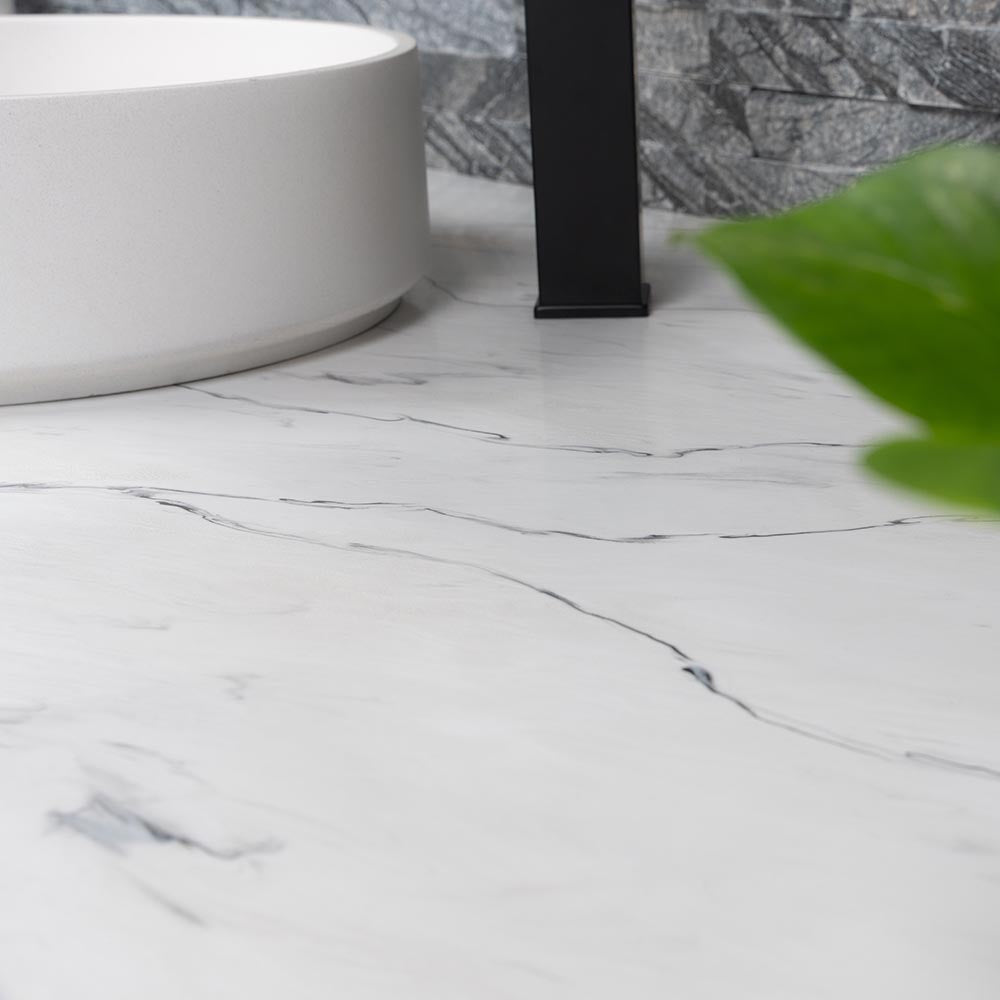
For years, homeowners have been drawn to the timeless appeal of white and light-colored countertops. From classic marble-inspired kitchens to modern minimalist spaces, bright white and light-colored surfaces continue to dominate design trends because they create a sense of openness, reflect natural light, and provide a clean backdrop that complements virtually any design style. Whether inspired by Carrara marble, white quartz, or other modern luxury interiors, white and light-colored countertops remain one of the most requested looks in kitchen and bath remodeling.
White and light-colored surfaces also have lasting appeal because they feel elevated and timeless instead of being tied to a short-term trend. That makes them a smart choice for homeowners who want a countertop design they can love now and feel confident about years down the road, whether they stay in the home or it comes time to sell.
Despite their coveted looks and vast popularity, white and light-colored countertops have always come with an important question for anyone considering a decorative countertop coating system:
Will epoxy yellow over time? The answer has historically been yes.
While epoxy countertop systems have transformed the remodeling industry by providing a durable, beautiful, and cost-effective alternative to natural stone surfaces, yellowing has remained one of the most common concerns associated with white and light-colored countertop designs.
Today, that conversation is changing.
After years of research, testing, and real-world application development, Stone Coat Countertops introduces APEX, a breakthrough countertop coating system engineered specifically to preserve true whites and light-colored countertop designs while delivering exceptional durability and long-term clarity.
 To understand what makes APEX different, it helps to look at why yellowing has been such a persistent challenge for white and light-colored countertop designs specifically.
For a more in-depth look at this topic, read our article, “Why Does Epoxy Yellow?”
Why Yellowing has Always Been the Biggest Challenge for White and Light-Colored Countertops
Epoxy countertop systems revolutionized surface refinishing by allowing homeowners to achieve the look of natural stone without the expense, demolition, and disruption of a full countertop replacement. Designs that once required costly slabs of marble, quartz, or granite could now be recreated over existing surfaces using decorative coating systems. Homeowners gained access to dramatic veining, rich stone movement, deep gloss, and custom aesthetics at a fraction of the cost of traditional renovations.
But for white and light-colored epoxy countertops, one problem kept showing up over time.
Early epoxy formulations were highly sensitive to UV light, which could trigger photo-degradation and cause rapid ambering on white and light-colored surfaces. While epoxy technology has improved over time, yellowing has remained a consistent challenge across the industry. Even with the addition of inhibitors, epoxy can still react to environmental factors such as UV exposure, heat, and oxidation, which can create an amber tint over time. This color shift is commonly referred to as yellowing.
For darker countertop designs, this gradual shift may not be especially noticeable. But white and light-colored countertops are different. When the goal is a bright, crisp, luminous white or light-colored surface, even subtle discoloration can become visible. A countertop that originally appeared brilliant white can slowly take on warmer cream or ivory tones over time.
This challenge has never been unique to a single manufacturer or product line. It has historically been a limitation of the category itself. While manufacturers continually improved durability, workability, and appearance, the reality of long-term discoloration remained the ceiling of the technology.
And as white and light-colored countertops became increasingly popular, the demand for a better solution grew stronger.
Why White and Light-Colored Countertops Require a Different Approach
Today's homeowners are seeking cleaner, brighter, and more refined spaces more than ever before. White and light-colored kitchens continue to dominate design magazines, social media feeds, and renovation shows because they create a classic look that feels both elegant and inviting. They make kitchens feel brighter, cleaner, and more open while still offering timeless resale appeal. Current homeowners are moving away from stark, flat whites and toward warmer, soft whites with natural veining that feel more organic, elevated, and stone-inspired. That shift lines up directly with Stone Coat’s aesthetic, giving customers a way to create the bright marble and natural stone looks they are already searching for.

The challenge is that white and light-colored surfaces leave little room for compromise. A color shift that might go unnoticed on a darker countertop can become much more apparent on a bright white design. As a result, homeowners often find themselves balancing their desire for white and light-colored countertops against concerns about long-term performance.
At Stone Coat Countertops, that challenge became the driving force behind years of research and development. The goal was not simply to improve existing technology. The goal was to rethink the entire system from the ground up and create a solution specifically engineered for the demands of modern white- and light-stone aesthetics.
Introducing APEX by Stone Coat: A Breakthrough in Countertop Coating Technology
After years of research, testing, refinement, and real-world application development, Stone Coat Countertops introduces APEX, a breakthrough countertop coating system engineered to redefine expectations for decorative surfaces.
APEX is not a reformulation of an existing product. Developed through more than 70 iterations, APEX represents a completely reimagined approach to countertop performance. Every component of the system was designed to work together to deliver luminous, enduring white- and light-stone aesthetics while providing the durability and performance homeowners expect from a premium countertop surface.
Rather than trying to manage the limitations of traditional epoxy, Stone Coat built APEX around aliphatic polyaspartic chemistry, a more UV-stable foundation designed to resist the yellowing that has long challenged white and light-colored countertop designs.
APEX reflects years of asking difficult questions, challenging long-held assumptions, and pursuing a higher standard for the industry. As Stone Coat Epoxy Pro, Mitch Quist explains, "APEX is the result of revisiting every aspect of the countertop pouring process and asking how we could make it better. We knew the industry deserved more, and we weren't willing to stop until we created a system that raised the standard entirely."
That commitment to innovation is what makes APEX more than a product launch. It represents a shift in what's possible for decorative countertop coatings.
Is APEX Right for White and Light Countertop Designs?
Yes, APEX was engineered specifically to preserve true whites and light-colored countertop designs over the long term. This makes it an ideal option for homeowners seeking bright white, marble-inspired, quartz-inspired, and other light-colored finishes that have traditionally been next to impossible to achieve with epoxy systems.
Because APEX is designed to resist yellowing, even in direct sunlight, it gives customers greater confidence when selecting white and light-colored surfaces. According to UV chamber testing done by Stone Coat, APEX is designed to provide 20+ years of color stability, helping maintain the clean, bright appearance of the finished countertop for years to come.

An APEX coating is designed to outlast the lifespan of a typical kitchen and offers long-term durability beyond many traditional natural stone options, including marble.
Polyaspartic vs. Epoxy: Why the Chemistry Makes the Difference for White Countertops
The difference between epoxy and APEX starts with the chemistry. Epoxy systems have improved over the years, often using additives and UV inhibitors to help slow yellowing. But for white and light-colored countertops, managing yellowing is not the same as building the system around a more color-stable foundation from the start.
APEX is made with aliphatic polyaspartic technology, which gives the system a more UV-stable base than epoxy. This is why APEX is not just another white countertop coating. The chemistry behind the system helps explain the purpose of each component that follows, from the primer and white dye to the countertop coating and finishing spray.
The Complete Stone Coat APEX Countertop System
Rather than relying on a single product to solve a complex challenge, Stone Coat developed APEX as a complete, 4-part countertop finishing system. Each component plays a specific role in creating a finished surface designed to preserve true whites and deliver exceptional long-term performance.
The system begins with APEX Poly Fuse Countertop Primer, a precision bonding primer engineered to adhere to surfaces such as laminate, tile, cultured marble, granite, metal, and MDF. By concealing underlying colors and patterns while ensuring exceptional adhesion, it establishes a smooth, consistent foundation for the layers that follow.
To create the bright, sophisticated appearance homeowners desire, APEX Poly White Countertop Dye blends into the coating to deliver pure white stone aesthetics with exceptional consistency and visual depth.
Next comes the APEX Polyaspartic Countertop Coating, an industry-leading UV-stable coating engineered specifically to preserve true whites and light-colored designs. This advanced formulation provides the clarity, durability, and long-term color stability that form the foundation of the APEX system.
Finally, APEX Surface Control Finishing Spray promotes bubble release and surface flow without the need for torching, helping create a smooth, seamless finish inspired by the elegance of natural stone.
Together, these components form a complete system designed to deliver a level of clarity, confidence, and performance that has historically been impossible to achieve in white and light-colored countertop coatings.
A New Era for White and Light-Colored Countertops
For years, homeowners who loved the look of white and light-colored countertops had to weigh aesthetics against concerns about long-term discoloration. While decorative countertop coatings delivered incredible value, beauty, and versatility, the limitations of existing technology remained part of the conversation.
APEX changes that entirely.
Stone Coat APEX was developed to redefine what's possible for white and light-colored countertops. Engineered with long-term color stability in mind, APEX is designed to overcome the yellowing concerns that have challenged epoxy systems for decades, giving homeowners and professionals greater confidence in bright, clean countertop designs.
This is not simply a new product entering the market. It is a breakthrough in countertop coating technology. A revelation built on years of research, development, and refinement. Most importantly, it signals a future where homeowners can confidently pursue the bright, luxurious white countertop designs they love without accepting the compromises that have historically accompanied them.
 The future of white countertops is here. Its name is APEX.
If you’re ready to build a white or light-colored countertop that stays true to color, explore the APEX Countertop System and see how Stone Coat makes bright stone and marble looks possible with better clarity and long-term color confidence.
Frequently Asked Questions
What is APEX?
APEX is a next-generation countertop coating system from Stone Coat Countertops, engineered for bright, high-end stone and marble looks with better color confidence, clarity, durability, and long-term performance.
Unlike epoxy, APEX is made with aliphatic polyaspartic technology designed to be poured thick, mimic the depth and movement of natural stone, and resist yellowing, even in direct sunlight. The system was built specifically for true whites and light-colored countertop designs, giving customers more control and confidence when creating bright surfaces.
Is it possible to apply APEX over existing countertops?
Yes. APEX can be installed over existing countertops, including existing epoxy countertops, as long as the surface is solid, stable, and properly prepared.
APEX Poly Fuse Countertop Primer is engineered to bond to a variety of surfaces, including laminate, tile, cultured marble, granite, metal, MDF, existing epoxy, and new builds. Each surface may require a different prep path, so follow the approved prep system for the specific countertop you are coating.
Do not apply APEX over failing substrates, loose material, peeling coatings, or surfaces that are not structurally sound. Solid and properly prepared is the rule.
How long does APEX take to cure?
APEX is a fast-curing system designed to reach full cure in approximately seven days, helping reduce downtime while delivering long-term durability.
Are white epoxy countertops a good idea?
White epoxy countertops can create beautiful marble and quartz-inspired designs. However, long-term color stability has historically been one of the biggest concerns with epoxy systems. APEX was engineered specifically to address those concerns and preserve true white and light-colored aesthetics.
How long will my countertop stay white?
APEX was engineered specifically to preserve true whites and light-colored countertop designs over the long term. Our UV chamber testing indicates 20+ years of color stability. An APEX coating is designed to outlast the lifespan of a typical kitchen and offers long-term durability beyond many traditional natural stone options, including marble.
Are polyaspartic countertops better than epoxy for white and light-colored surfaces?
For white and light-colored countertop designs, polyaspartic technology offers a stronger foundation than epoxy because it is more color-stable against UV exposure. That matters on bright surfaces, where even a slight amber tint can be easy to see.
Epoxy coatings can yellow over time when exposed to sunlight, heat, and oxidation. While additives and UV inhibitors can help slow that process, APEX takes a different approach by using aliphatic polyaspartic technology as the base of the system.
For homeowners who want bright white, soft white, Carrara, or light marble-inspired countertops, APEX provides a better path for long-term color confidence than a traditional epoxy coating.


