

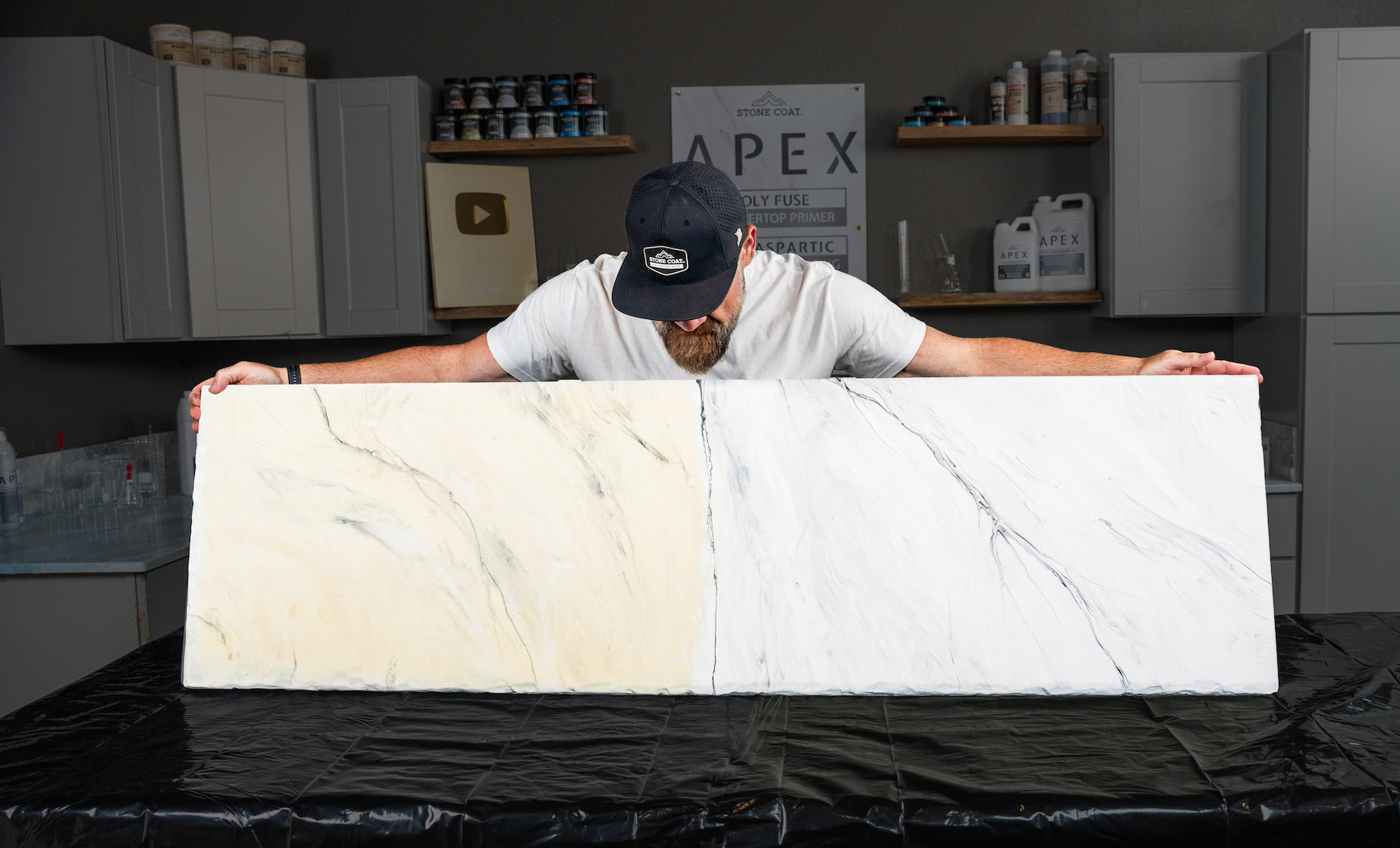
El epoxi amarillea porque la luz ultravioleta, el calor y la oxidación degradan gradualmente su estructura polimérica con el paso del tiempo, provocando que la resina pase de ser transparente a un tono amarillo o ámbar. Esta es una característica natural de la química del epoxi, no un defecto de fabricación, y afecta a todos los sistemas epoxi en cierto grado. Entender por qué sucede le ayudará a elegir los productos adecuados, establecer expectativas realistas y tomar medidas para ralentizar el proceso.
El epoxi es conocido por su durabilidad y su hermoso acabado, pero el amarilleamiento ha sido durante mucho tiempo uno de los mayores desafíos de la industria, especialmente en diseños blancos y de colores claros. Para entender por qué ocurre, es útil comprender primero qué causa que el epoxi amarillee.
La luz UV y el amarilleamiento del epoxi: La causa principal
La causa número uno del amarilleamiento del epoxi es la exposición a la luz ultravioleta (UV). Las resinas epoxi no son intrínsecamente estables a los rayos UV, lo que significa que la luz solar degrada gradualmente su estructura molecular.
Cuando los rayos UV inciden sobre el epoxi curado, desencadenan un proceso llamado fotodegradación. Esto descompone las cadenas de polímero dentro del material, lo que lleva a un cambio visible en el color, generalmente de transparente a amarillo o ámbar.
Para ayudar a ralentizar este proceso, Stone Coat incorpora inhibidores UV en sus fórmulas. Estos aditivos están diseñados para retrasar la decoloración, no para eliminarla por completo. Esa distinción es importante porque ningún sistema epoxi puede permanecer perfectamente transparente para siempre bajo la exposición a los rayos UV. Incluso la luz solar indirecta, como la que entra por las ventanas, puede causar este efecto con el tiempo. Es por eso que a menudo verá que el amarilleamiento es más pronunciado cerca de ventanas, puertas de garaje o bordes exteriores.
¿Los inhibidores UV realmente evitan que el epoxi amarillee?
Los inhibidores UV ayudan a ralentizar el proceso de amarilleamiento, pero no pueden detenerlo por completo. Existen dos tipos principales utilizados en los sistemas de recubrimiento de alta calidad: absorbedores UV, que ayudan a interceptar los rayos UV antes de que puedan dañar el epoxi, y HALS (estabilizadores de luz de amina impedida), que ayudan a interrumpir el proceso de degradación después de que comienza. Las fórmulas de Stone Coat Countertops utilizan tecnologías avanzadas de protección UV para ayudar a mantener la claridad y ralentizar la decoloración con el tiempo. Sin embargo, incluso los sistemas epoxi de primera calidad mostrarán eventualmente cierto grado de oscurecimiento cuando se expongan a la luz UV durante períodos prolongados.
¿Cómo causan el amarilleamiento del epoxi el calor y la oxidación?
La exposición a los rayos UV es el principal motor de la fotodegradación, pero no es el único factor. El epoxi es un material termoestable, lo que significa que continúa respondiendo a las condiciones ambientales incluso después de curarse. Las temperaturas más altas pueden acelerar el proceso de envejecimiento, incluido el cambio visual hacia un tono más cálido o ligeramente ámbar.
El oxígeno también contribuye al mismo proceso de degradación. La oxidación (reacción con el oxígeno en el aire) altera la estructura química de la resina curada.
Con el tiempo, estos procesos forman nuevos grupos químicos, como compuestos de carbonilo, que cambian la forma en que el material refleja la luz, dándole ese tinte amarillento. Esto significa que incluso el epoxi que se mantiene en interiores, lejos de la luz solar directa, puede oscurecerse lentamente a medida que envejece.
El amarilleamiento del epoxi con el paso del tiempo: Por qué es inevitable
Incluso en condiciones ideales, el epoxi terminará amarilleando. Es simplemente parte del ciclo de vida natural de los epoxis. Piense en ello menos como un fallo del material y más como un proceso de envejecimiento gradual, similar a como la madera se oscurece o los acabados adquieren pátina con el tiempo.
Los epoxis de alta calidad, incluidos los sistemas tradicionales para encimeras de Stone Coat Countertops, están formulados con inhibidores UV y estabilizadores diseñados para ralentizar el amarilleamiento tanto como sea posible. Sin embargo, el amarilleamiento sigue siendo una limitación conocida de la química del epoxi. Este desafío es una de las fuerzas impulsoras detrás del desarrollo de APEX, una nueva tecnología de recubrimiento para encimeras diseñada específicamente por Stone Coat para redefinir las expectativas sobre la estabilidad del color a largo plazo.
¿La calidad del epoxi afecta la rapidez con la que amarillea?
No todos los epoxis amarillean al mismo ritmo. La formulación juega un papel importante:
- Las resinas de menor calidad tienden a amarillear más rápido debido a que contienen menos estabilizadores y una química menos refinada.
- Los sistemas de gama alta incluyen absorbedores UV y HALS (estabilizadores de luz de amina impedida), que ralentizan significativamente el proceso.
Es por eso que los epoxis para encimeras de grado profesional están diseñados para mantener la claridad durante más tiempo, especialmente en ambientes interiores.
¿Pueden una mezcla o almacenamiento deficientes causar el amarilleamiento del epoxi?
Sí. El almacenamiento, la manipulación y la mezcla inadecuados pueden contribuir al amarilleamiento prematuro, pero muchos de estos problemas se pueden evitar con la preparación y las técnicas adecuadas.
El componente endurecedor es particularmente susceptible a la oxidación. La exposición al aire, la humedad o el calor excesivo puede hacer que el endurecedor se oscurezca con el tiempo, lo que puede afectar la apariencia de la superficie terminada. Para obtener los mejores resultados, los materiales epoxi siempre deben almacenarse de acuerdo con las recomendaciones del fabricante y utilizarse dentro de su vida útil prevista.
Los errores de mezcla también pueden acelerar la decoloración. Una proporción de mezcla incorrecta, especialmente cuando la relación resina-endurecedor no es la adecuada, es un factor bien conocido que contribuye al amarilleamiento prematuro. Una mezcla inadecuada puede afectar aún más la calidad del curado, la claridad y la estabilidad del color a largo plazo.
Además, las resinas y endurecedores epoxi envejecen naturalmente con el tiempo. A medida que los materiales permanecen almacenados, pueden oxidarse gradualmente y desarrollar color en el contenedor, lo cual puede volverse visible en el epoxi curado. Por esta razón, los materiales frescos y almacenados correctamente suelen ofrecer la mejor claridad y rendimiento de color.
Los sistemas epoxi de alta calidad fabricados a nivel nacional suelen llegar a los clientes poco después de su producción, a diferencia de los productos que pueden pasar largos períodos en tránsito y distribución. Menos tiempo en almacenamiento puede ayudar a reducir la decoloración relacionada con la edad y contribuir a una mejor apariencia y rendimiento general.
Color y diseño del epoxi: Cómo varía la visibilidad del amarilleamiento
Uno de los factores más importantes, y a menudo pasados por alto, al hablar del amarilleamiento del epoxi es la visibilidad.
Todos los sistemas epoxi experimentarán cierto grado de cambio de color con el tiempo, pero eso no significa que el amarilleamiento siempre sea perceptible.
- Las superficies transparentes, blancas y de colores muy claros tienden a mostrar más el amarilleamiento. Por el contrario, los colores más oscuros, los efectos metálicos, las vetas y los diseños con patrones ayudan naturalmente a ocultar cambios sutiles de color. Estos elementos de diseño son excelentes opciones para crear superficies con apariencia de piedra real donde la decoloración rara vez se nota, incluso después de muchos años de uso.
- Los diseños que imitan la piedra natural, una opción popular para encimeras de epoxi, a menudo envejecen con mayor elegancia porque los ligeros cambios de color se mezclan con el patrón en lugar de destacar. Como resultado, la superficie mantiene su atractivo visual durante mucho más tiempo.
Es por eso que muchos profesionales han utilizado con éxito sistemas epoxi de alta calidad para encimeras oscuras o de colores intensos que siguen luciendo muy bien con el tiempo. Históricamente, sin embargo, las encimeras de epoxi blanco se han tratado con más cautela, especialmente en áreas con una exposición significativa a la luz natural, porque incluso un leve amarilleamiento puede volverse visible.
¿El amarilleamiento del epoxi afecta su rendimiento?
Los sistemas epoxi para encimeras de Stone Coat están formulados como epoxi 100% sólidos, lo que significa que se curan formando una superficie duradera y no porosa. La integridad estructural, la resistencia, la adherencia y el rendimiento permanecen intactos, incluso si el color cambia ligeramente con el tiempo.
¿Se puede evitar que el epoxi amarillee?
No puedes evitar por completo que el epoxi amarillee, pero puedes ralentizarlo significativamente:
- Limite la exposición directa y prolongada a los rayos UV
- Utilice capas de acabado resistentes a los rayos UV
- Elija sistemas epoxi de alta calidad de origen nacional
- Evite diseños de color blanco puro o transparentes en áreas con mucha luz
- Siga las instrucciones midiendo con precisión y mezclando minuciosamente
Estos pasos pueden prolongar significativamente el aspecto "transparente" y natural de su recubrimiento.
El papel de las capas de acabado en la protección UV
Aunque ningún recubrimiento puede prevenir completamente los cambios relacionados con los rayos UV, agregar una capa de acabado puede ayudar a extender la vida útil visual y la durabilidad de la superficie, especialmente en ambientes de uso intensivo o mucha luz.
Stone Coat Countertops diseña sus sistemas epoxi con:
- Inhibidores UV para ralentizar la fotodegradación
- Fórmulas 100% sólidos para estabilidad y durabilidad
- Una capa de acabado opcional apta para uso alimentario llamada Ultimate Top Coat, que añade durabilidad, resistencia a los arañazos, protección UV, resistencia a las manchas y resistencia al calor.
En muchos sistemas, una capa de acabado resistente a los rayos UV es la mejor manera de proteger la claridad a largo plazo, especialmente en cocinas, garajes o espacios con luz natural.
Qué hacer si su epoxi ya ha amarilleado
Si su epoxi ya ha desarrollado un tinte amarillo o ámbar, la mejor solución depende de la gravedad de la decoloración y el estado de la superficie.
Para un amarilleamiento leve, lijar la superficie y aplicar una nueva capa de acabado puede ayudar a mejorar la apariencia y restaurar la claridad. Este enfoque es más efectivo cuando la decoloración se limita a las capas superiores del recubrimiento.
Para proyectos decorativos, algunos usuarios optan por incorporar color adicional, vetas o tintes para ayudar a disimular el amarilleamiento. Aunque esto puede mejorar la apariencia, generalmente debe verse como una solución cosmética en lugar de un arreglo permanente.
Para un amarilleamiento significativo, renovar o reemplazar el sistema de recubrimiento puede ser la mejor opción a largo plazo. A medida que la industria continúa evolucionando, se han desarrollado tecnologías más nuevas, como Stone Coat APEX, específicamente para abordar los desafíos de estabilidad del color que históricamente han afectado a los sistemas epoxi tradicionales, particularmente en diseños blancos y de colores claros.
Para futuros proyectos, la mejor defensa contra el amarilleamiento es elegir un sistema de recubrimiento de alta calidad como APEX, seguir los procedimientos adecuados de almacenamiento y mezcla, y seleccionar productos diseñados teniendo en cuenta la estabilidad del color a largo plazo.
APEX de Stone Coat: Un nuevo estándar para la estabilidad del color
Durante años, las encimeras de epoxi han ofrecido una alternativa atractiva, duradera y rentable a la piedra natural y manufacturada. Sin embargo, el amarilleamiento seguía siendo uno de los desafíos más persistentes de la industria, especialmente para superficies blancas y de colores claros.
Stone Coat desarrolló APEX específicamente para abordar ese desafío. El Sistema de Encimeras Stone Coat APEX fue diseñado con la estabilidad del color a largo plazo como objetivo principal. El resultado es un sistema de recubrimiento para encimeras diseñado para preservar diseños brillantes y limpios, ayudando a los propietarios y profesionales a superar las limitaciones que históricamente han afectado a las superficies de epoxi.
Con la introducción de APEX, los propietarios y profesionales ahora tienen acceso a una nueva opción creada específicamente para preservar el aspecto limpio y brillante que exigen los diseños modernos de encimeras, con una estabilidad de color que debería durar más que la vida útil de la propia encimera.
¿Qué diferencia a APEX del epoxi?
A diferencia del epoxi, APEX utiliza tecnología de poliaspártico alifático diseñada para verterse en capas gruesas, creando la profundidad, el movimiento y la apariencia de piedra natural por los que son conocidos los recubrimientos decorativos para encimeras.
El proceso de aplicación también es diferente. APEX se mueve menos que el epoxi, gelifica más rápidamente, utiliza un proceso de control de burbujas sin soplete y requiere un tiempo más disciplinado durante la instalación. Estas características brindan un mayor control durante la aplicación y ayudan a crear resultados consistentes.
En lugar de depender únicamente de inhibidores UV y estabilizadores para ralentizar la decoloración, APEX fue diseñado desde cero pensando en la estabilidad del color, ofreciendo un enfoque diferente a uno de los desafíos más comunes de la industria de recubrimientos.
¿Listo para construir una encimera que mantenga su color original?
Si siempre ha querido una encimera blanca brillante, inspirada en el mármol o de color claro, pero le preocupaba que amarilleara con el tiempo, no está solo.
Con la tecnología poliaspártica y diseñado específicamente para la estabilidad del color a largo plazo, APEX le brinda la confianza para crear los diseños blancos y de colores claros que siempre ha querido, sin las preocupaciones de amarilleamiento que históricamente han limitado al epoxi.
La encimera de sus sueños no debería cambiar de color con el tiempo. Con APEX, no tiene por qué hacerlo.


